
MCPs Change the Design Surface
When tools can transport logic, context, and functions, interoperability becomes product strategy.

Most AI product teams are making the same category error. They are using AI to move faster, and they are mistaking that acceleration for system design.
Generative tooling has made it easier to prototype flows, write code, generate UI, and ship features at a pace that would have felt unrealistic not long ago. That matters. It changes how designers and engineers work. But an AI-native application is not just a faster way to produce software. It is a different kind of software. It is a system that generates behavior.
That changes the design problem.
Once software starts producing decisions, drafts, recommendations, transformations, and workflows at runtime, the product is no longer defined by screens alone. It is defined by how context, logic, capabilities, and constraints move through a system. That means teams need two kinds of systems thinking at once, and most are over-investing in only one of them.
The first kind is micro systems thinking. This is the layer most teams are focused on today. It includes the tool itself, the interaction model, the prompt structure, the feedback loop, the review step, and the way a user corrects the system when it gets something wrong. This layer matters because it is where quality becomes visible. It is where the system feels useful or frustrating.
The second kind is macro systems thinking. This is the layer that decides whether the product holds together as it grows. It includes orchestration, interoperability, shared context, governance, capability boundaries, and the question of how the system participates in a wider ecosystem. This layer matters because it determines whether intelligence compounds or fragments.
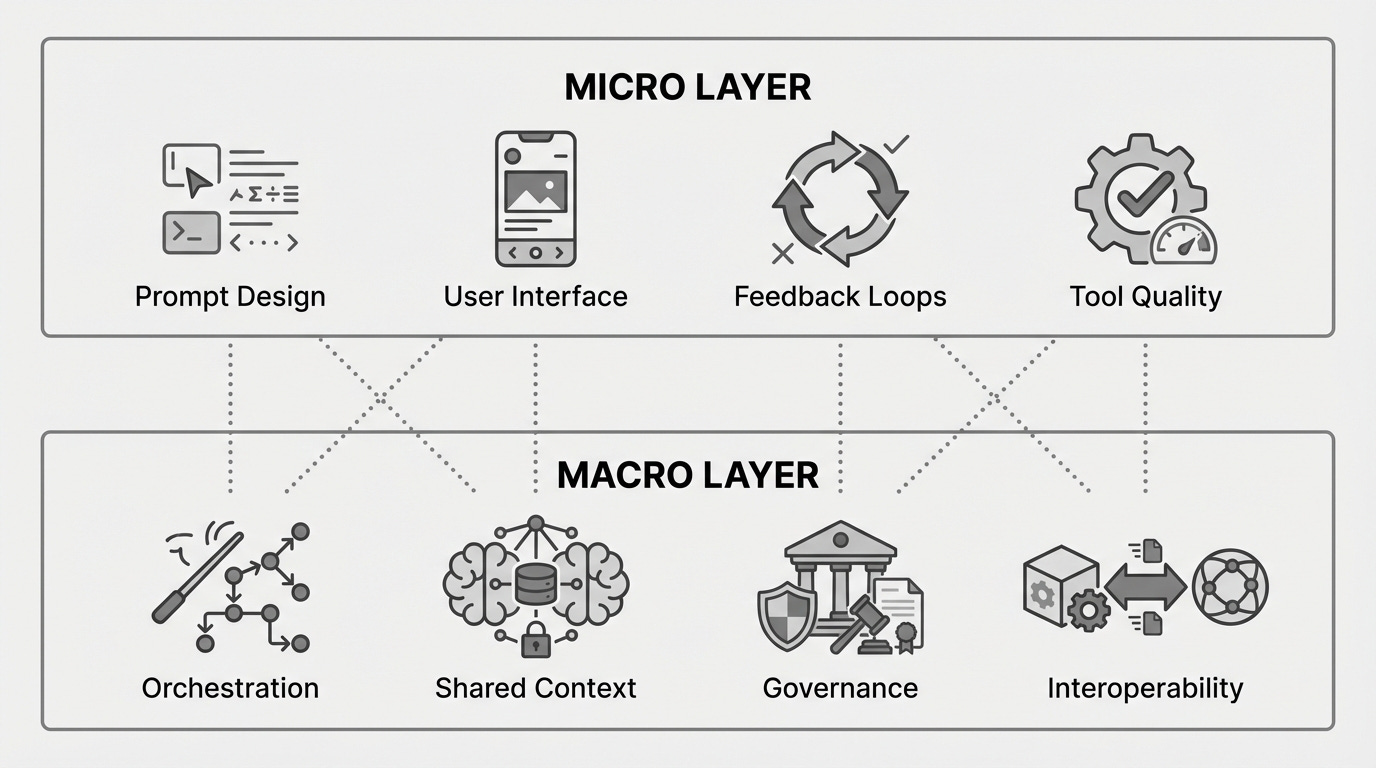
The problem is not that teams care too much about the micro layer. The problem is that generative building makes the micro layer unusually seductive. It is easier to see. Easier to demo. Easier to improve in short cycles. You can tighten a prompt, improve a response, smooth an interaction, and feel immediate progress. Meanwhile, the actual system underneath may still be under-designed.
That is how teams end up with AI products that look sharp in isolated moments and break down as systems. You see agents with no shared memory. Brand logic copied into multiple workflows. Research outputs that never properly inform execution. Interfaces that can generate impressive drafts but cannot explain what sources were used, what assumptions were applied, or where a human can intervene. The product feels intelligent at the edge of a task and incoherent across the full workflow.
This is where MCPs start to matter.
The most useful way to think about an MCP is not as a connector for moving data from one place to another. It is as a transport layer for capability. A well-designed MCP can carry context, callable functions, and logic in a form that another system can use. That is a very different design surface from a traditional integration.
When you design an MCP, you are not just deciding what information to expose. You are deciding what parts of your system can travel, what assumptions travel with them, what actions can be invoked, and how another environment can understand and trust the result. In other words, MCP design is product design.
That matters because AI-native products will not live inside a closed environment for long. Your tools will be used by agents you did not build, inside applications you do not control, in workflows you did not define. The real question is no longer “does this feature work inside our app?” The real question is “does this capability remain legible, useful, and governed when it participates in a broader ecosystem?”
That is a macro design question.
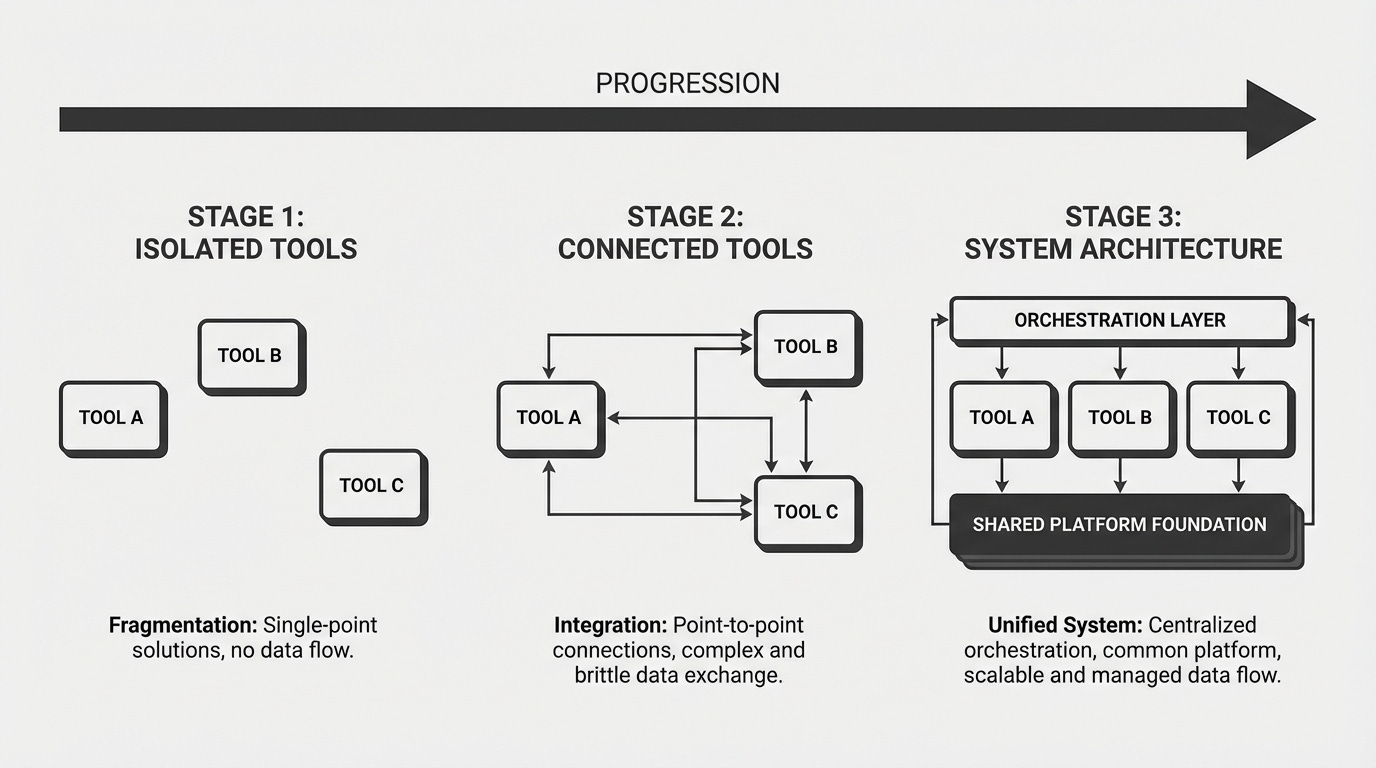
Take a marketing and advertising system as an example. You might build one MCP focused on industry research and landscape monitoring. Its job is to watch the market continuously, identify movement, summarize signal, and make that available as a callable capability.
You might build a second MCP for brand, style, tone, and messaging constraints. Its job is to act as the canonical reference for how the company should sound, what it can say, and where the boundaries are.
Then you might build a third MCP for execution, with tools for presentations, campaign formats, briefs, and other deliverables.
Individually, each of those tools can be useful. But the real value appears only when they work as a system.
Scenario: imagine that all three capabilities sit on top of a shared semantic layer that holds the company’s audience definitions, campaign history, strategic priorities, approved claims, and current market context. An orchestration layer then coordinates the workflow. Research detects a shift in the competitive landscape. Brand interprets what that means for positioning. Execution generates a new presentation, brief, or asset package with that context already applied. Review gates determine what a human must approve, what the system can update automatically, and what gets logged for traceability.
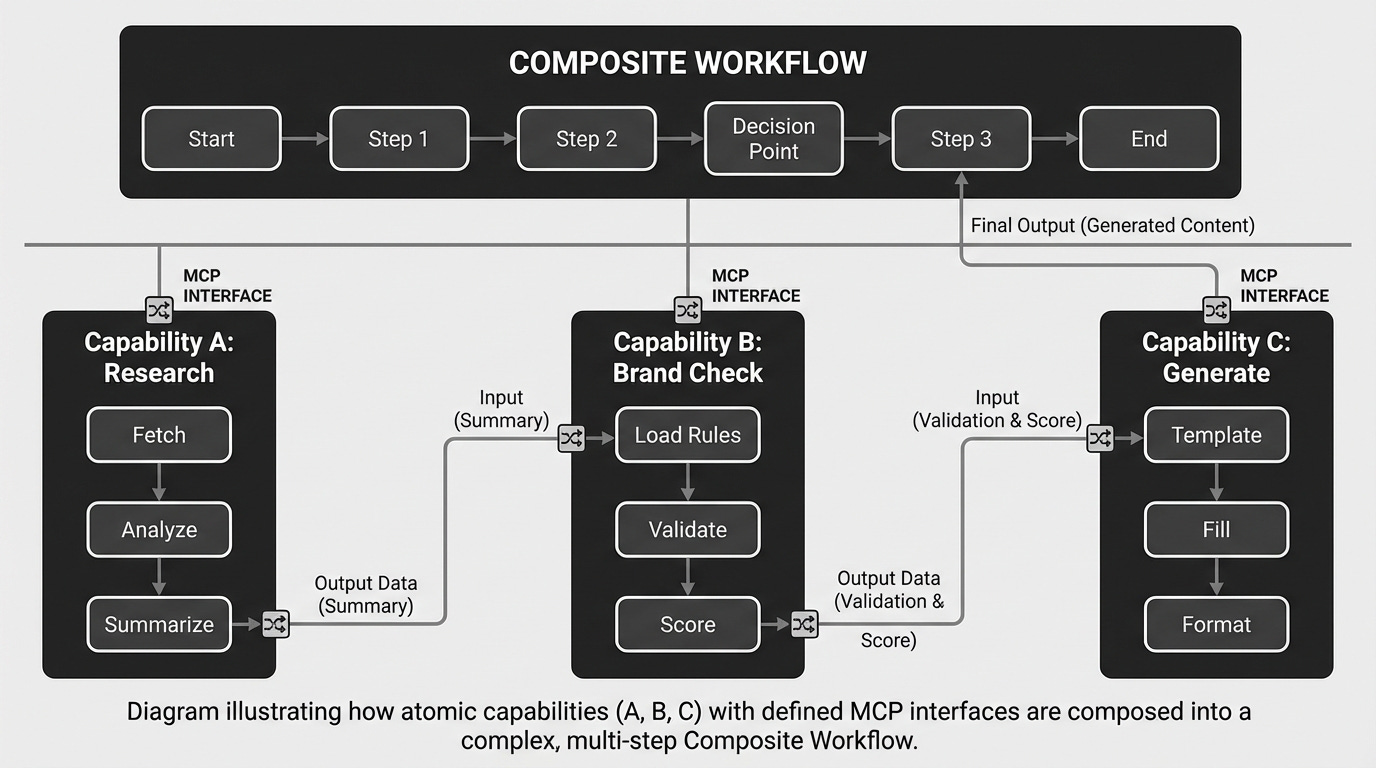
In that setup, the product is not “an agent that makes slides” or “a tool that summarizes the market.” The product is a coordinated system of intelligence with a stable source of context, explicit handoffs, and reusable capabilities.
Without that macro design, the same tools become much less valuable. Research drifts from brand. Execution relies on stale assumptions. Different agents produce work that sounds like it came from different companies. Teams spend more time checking coherence than benefiting from automation. The system moves fast, but it does not compound.
This is the trap many builders are falling into. They are optimizing for the generative act of building and under-designing the system being built.
That is understandable. AI makes velocity visible. It gives teams a powerful local loop: build, test, refine, repeat. But local improvement is not the same as system quality. In AI-native products, the harder and more strategic work sits one layer up. It sits in the design of context, interoperability, orchestration, permissions, and review.
That also means leaders need to change what they treat as product infrastructure.
The important decisions are no longer limited to roadmap priority and feature scope. Leaders now have to decide what context is canonical, who owns it, which capabilities should be exposed as reusable system primitives, what intervention rights humans retain, and where governance must be embedded in the workflow itself. Someone has to own the semantic layer. Someone has to own orchestration logic. Someone has to decide how the system participates in external environments instead of assuming the product boundary stops at the interface.
This is also why the micro layer still matters so much. Good macro design does not excuse weak tool design. At the micro level, the product still needs clear intent capture, constrained generation, visible reasoning inputs, correction loops, and reliable review surfaces. A good generative interface does not simply ask for a prompt. It captures enough structure to make the task legible, carries the right context into execution, and shows the user where to adjust or override the system. The micro layer is where trust is earned interaction by interaction. The macro layer is where that trust remains durable across the system.
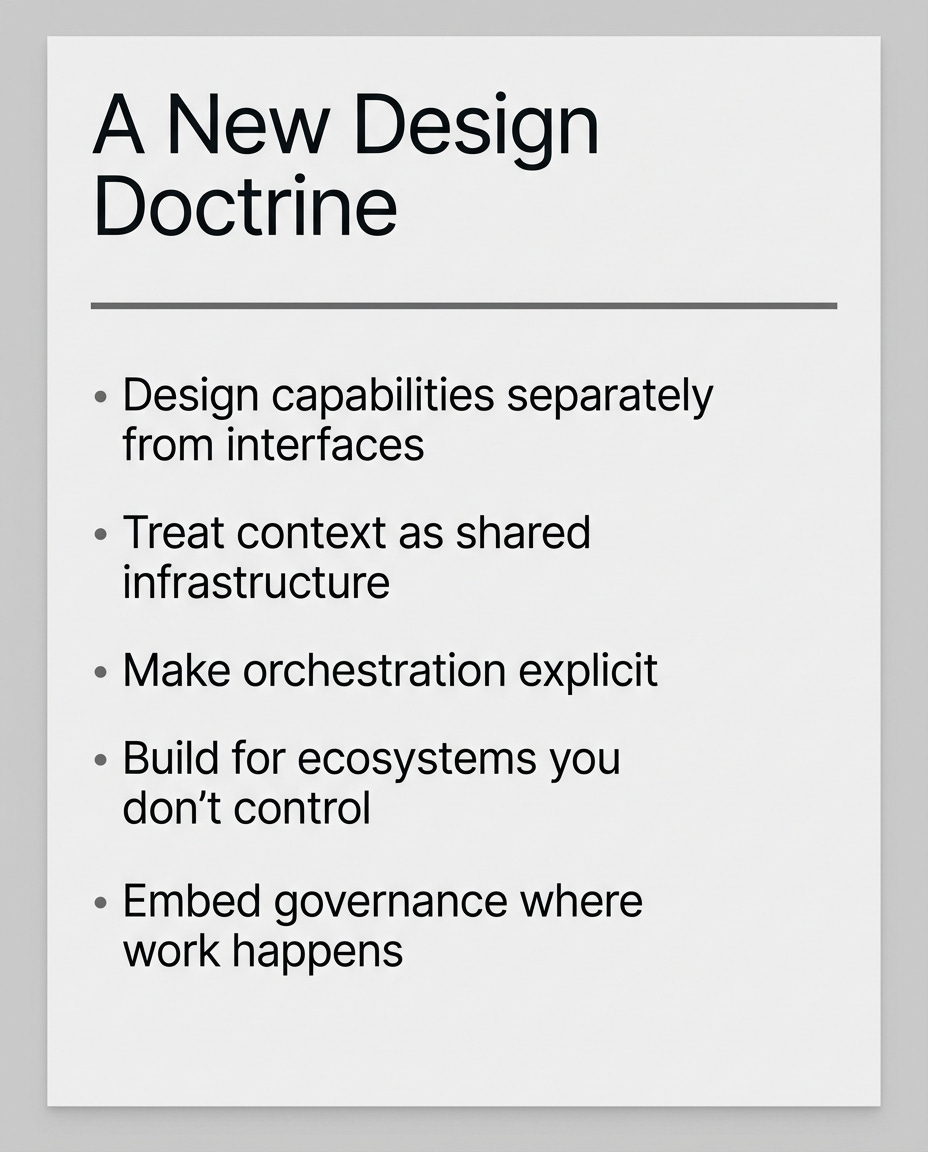
A useful design doctrine for AI-native products is starting to come into focus:
Design capabilities separately from interfaces
Treat context as shared infrastructure, not prompt residue
Make orchestration explicit, with clear handoffs and owners
Build for ecosystems you do not control
Embed governance where the work happens, not in policy after the fact
The deeper shift is this: we are moving from building tools to designing interoperable systems of intelligence.
That sounds abstract until you see where products are failing. They are not failing because teams lack creativity. They are failing because the build process has become so fast that it can hide structural weakness. The system looks impressive at the point of interaction while remaining brittle at the point of coordination.
The winners in AI-native software will not be the teams that simply generate more features, faster. They will be the teams that design both layers well: the micro layer where work gets done, and the macro layer where capabilities stay coherent, portable, and governable across an ecosystem.
In the next era of software, that is the real design job.