
Narrative Velocity Is Now Operating Discipline
Product velocity forces narrative velocity. The companies that keep up will treat positioning as a maintained system, not a yearly artifact.

Your January positioning deck is already aging
Not because the team did bad work. Not because the claims were weak. Not because the positioning exercise was a waste of time.
Because the market changed.
I learned in a world where the message was supposed to last. You could spend January in a conference room debating pillars, message boxes, proof points, and competitor claims. Then you could hand the finished deck to sales enablement, demand gen, events, web, and comms with some reasonable confidence that it would hold.
That single document would drive the trade show booth copy, webinar abstracts, pricing page, objection handling guides, and competitive battle cards until the next annual planning cycle.
Sometimes the market would interrupt. A competitor would announce something. A feature would land. A customer pattern would become too obvious to ignore. You would patch the messaging, send out an update, and move on.
But the structure held. The pillars held. The category held. The vocabulary held.
That model was not foolish. It was calibrated to a slower market. The message could last because the environment around it lasted.
That assumption no longer holds.
The language is moving faster
Over the last few weeks, I have been deep in competitive intelligence data for the company I work at now, Veylan, and the pattern is hard to unsee.
The market is not just moving faster. The language is moving faster.
Five months ago, “agentic” still felt like a term people were trying on. Now it is treated like a product category. Five months ago, MCP looked like something Anthropic had shipped that only a narrow group of people were tracking. Now, in the data I am looking at, major vendors, agencies, and platforms are building around it, explaining against it, or trying to absorb it into their own story.
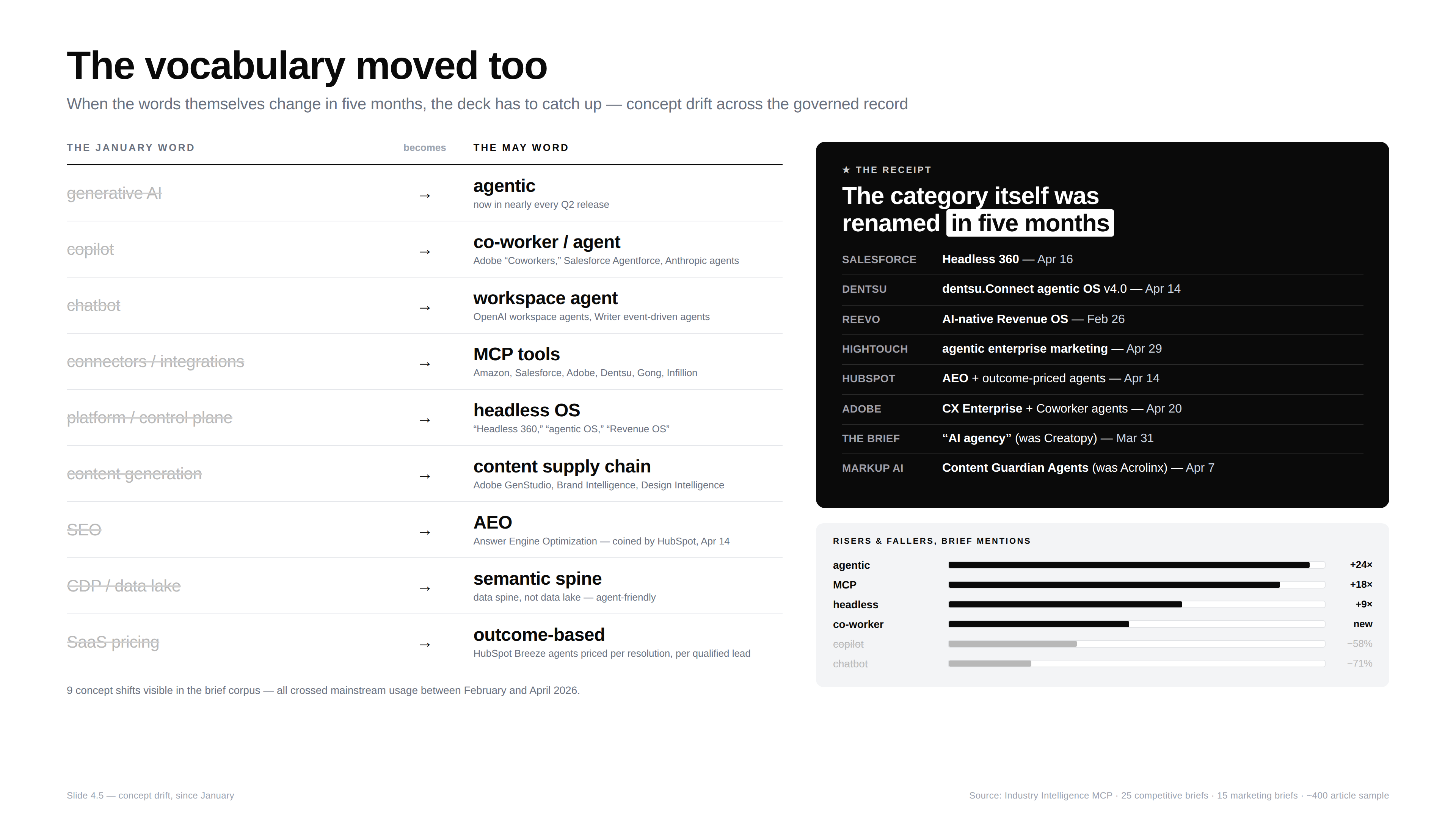
Five months ago, the words I used to describe my own category were one set of words. Now they are different.
The specifics will keep aging. Some terms will fade. Some architectural bets will matter less than expected. Some competitors will overstate what they have.
That is not the point.
The point is that buyer language, board-level questions, competitive framing, and category architecture are now changing faster than most companies can update the materials meant to guide the field.
Product velocity creates narrative debt
The velocity conversation usually starts with engineering: ship faster, shorten release cycles, move from quarters to weeks, from weeks to days.
That matters. But product velocity creates a downstream problem. Everything around the product has to be reinterpreted at the same pace.
If a category gets renamed in March, your sales team cannot wait until January to learn the vocabulary your prospects’ boards are already using. If a competitor reframes their positioning in April, your battle card cannot stay wrong until the next quarterly refresh. If a new architectural pattern becomes part of the buyer conversation in February and you do not have a position on it by March, you are not behind in a polite, recoverable way. You are absent from a conversation that matters.
The product team has to keep up. So does marketing. So does sales enablement. So do demand gen, web, comms, customer success, analyst relations, and the executive team.
The narrative itself has to keep up.
Most companies are not structured for that. Product ships continuously. Messaging ships at SKO. Product gets versioned. Messaging gets refreshed. Product has telemetry. Messaging has decks, opinions, and a calendar invite for next year’s planning cycle.
That gap creates narrative debt: stale internal materials that quietly tax every customer conversation.
The answer is not to rewrite the messaging every week. That just turns annual planning into a faster treadmill.
The answer is a different operating model.
Build the positioning spine
At Veylan, we have been building that model around something I call the spine: a canonical product spec, one file, that defines what the product is, who it is for, what makes it different, and what the company currently believes about the market.
The spine is not a brand deck. It is not a campaign brief. It is not a sales narrative that gets rebuilt from scratch every few months.
It is the source material those artifacts derive from.
Sales decks derive from it. Battle cards derive from it. Web copy derives from it. Internal POVs derive from it. Board updates derive from it. In a less direct way, even this post derives from it.
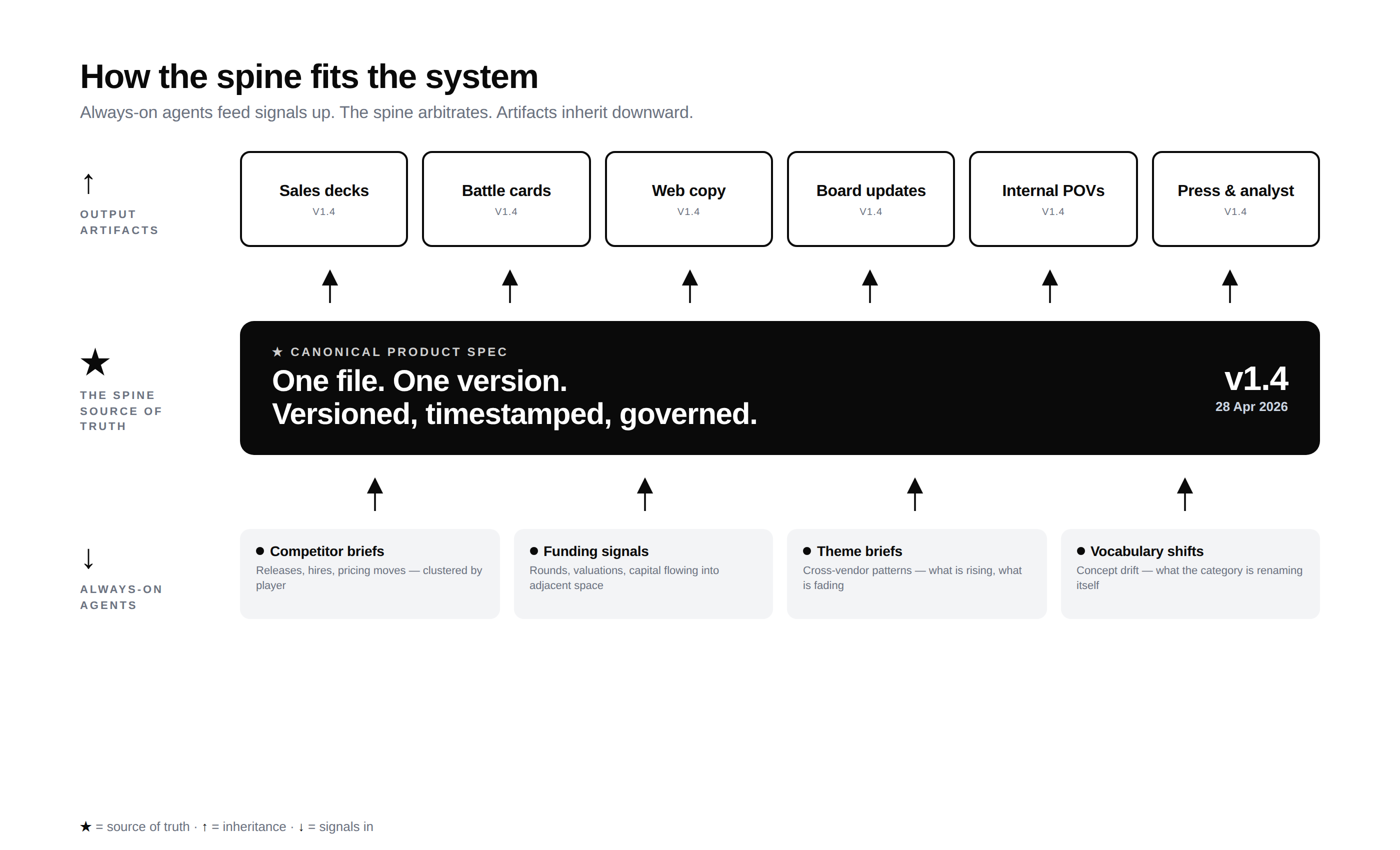
The spine sits between strategy and execution. Above it are the durable decisions: what customer problem matters, what market thesis we believe, what claims we can defend, and what lines we will not cross. Below it are the expressions that need to move: talk tracks, competitive frames, website language, objection handling, category vocabulary, and campaign copy.
When something meaningful changes about the product or the market, we update the spine. The artifacts that depend on it inherit the change.
A maintained positioning system needs four parts:
A canonical spine that captures product identity, audience, differentiation, market thesis, vocabulary, competitive frame, and operating boundaries.
A signal layer that monitors market movement across announcements, funding events, blog posts, earnings calls, customer conversations, and competitor claims.
A review gate that decides what is noise, what is signal, and what requires a change to the company’s point of view.
A propagation loop that moves approved updates into sales decks, battle cards, web copy, internal POVs, board materials, and enablement notes.
That may sound like tooling, but it is really operating discipline.
The spine forces a single source of truth. No quiet version drift between what marketing says, what sales says, what the website says, and what the product team says.
The signal layer keeps the company from waiting on a quarterly research project to learn that the market conversation already moved.
The review gate keeps speed from turning into noise.
The propagation loop makes sure a positioning change does not stay trapped in the head of one product marketer or buried in a Slack thread.
Agents make judgment easier to aim
Underneath the spine, we run a set of always-on agents.
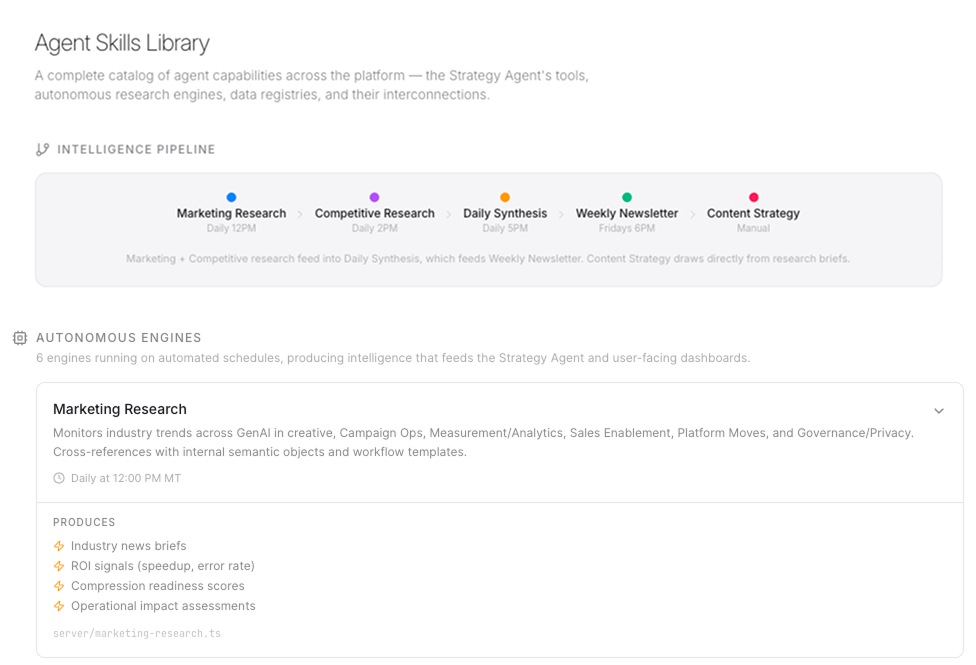
They ingest press releases, product announcements, funding events, blog posts, earnings calls, and other market signals. They cluster those signals into briefs by competitor and by theme. They flag the moves that matter: a competitor entering territory we had called whitespace, a new architecture becoming part of the category conversation, or a shift in the language customers and vendors are using to describe the problem.
The agents do not replace human judgment. They make judgment easier to aim.
That distinction matters. Always-on positioning cannot mean the company reacts to every headline. Most market noise is still noise. The value of the system is not that it changes the narrative automatically. The value is that it surfaces the right deltas for review before those deltas become field confusion.
The mid-year deck I built last week ran against the current spine, pulling from agents that had ingested more than 2,500 articles since January. The point of the deck was not to restate the annual narrative with fresher examples.
The deltas were the deck: what changed, when it changed, and what it means for where we play.
That is the shift.
In the old model, a mid-year messaging update asks, “Do we need to rewrite the deck?”
In the new model, the better questions are: What changed in the market? What did we already believe? Does that belief still hold? What needs to be revised? Which artifacts inherit the change? Who needs to know by Friday?
Govern the delta
A living document without governance becomes drift. A living document with clear review rights becomes a control surface.
Leaders have to make the ownership explicit. Who owns the spine? Who can propose a change? Who approves revisions that affect the field? What level of evidence is required before the company changes language? When does a narrative update need legal, comms, product, or executive review?
These questions are not bureaucracy. They are how you keep speed from turning into confusion.
There is risk in changing the narrative too often. Teams can get whiplash. Sales can lose confidence. Customers can hear inconsistency.
But there is also risk in changing too slowly. The company can sound dated. Reps can answer modern questions with old talk tracks. Competitors can define the terms of the conversation while you wait for the next planning cycle.
The goal is not constant motion.
The goal is controlled adaptation.
The marketing job changed
This is the mindset shift marketing now requires.
You have to get comfortable with the fact that the thing you said in January may not be the thing you say in May. You have to get comfortable revising a narrative you spent quarters building. You have to get comfortable telling the sales team that part of the SKO talk track is now obsolete, here is the update, the new version ships Friday.
That does not mean every opinion is temporary.
It means every opinion needs a feedback loop.
The marketers who will do well in this environment are the ones who can hold two things at once: a strong view of where the market is going, and a willingness to update that view when the market provides better evidence.
They need judgment, taste, and receipts. They need to know when a new term is noise, when it is a buyer signal, and when it requires a company-level response.
That is a different job than the one I learned.
The deliverable used to be “the message.” Now the deliverable is the discipline of keeping the message current.
Not reactive. Not scattered. Current.
Durability moved up a layer
Durability is still real. It has just moved up a layer.
The specific words will not last. The specific competitors may not all matter twelve months from now. The specific architectural bets will get validated, renamed, or replaced.
None of that is where durability lives anymore.
Durability lives in the capability to notice that something has shifted, understand what it means, decide how the company should respond, and equip the rest of the organization to operate in the new reality.
Call it always-on positioning.
Five months from now, I may read this post and see that some of the language has already aged. That is not a weakness in the argument. It is the argument.
The job is not to write a message that lasts forever.
The job is to build the system that keeps the company from going stale.